Circular No. 03/2026/TT-BYT: Abolition of Cosmetic Advertising Content Approval Procedures and Shift to Post-Market Surveillance
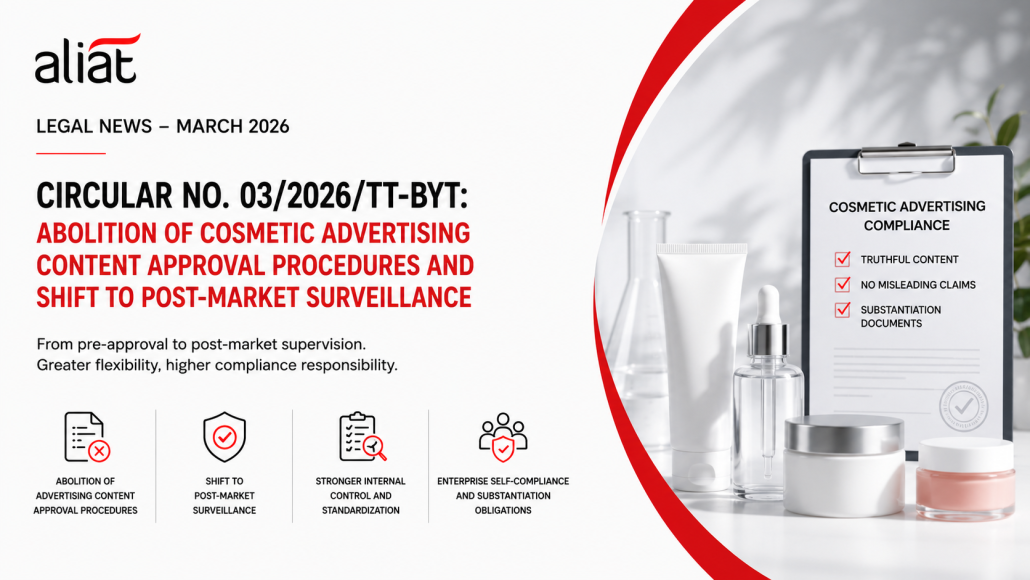
On 12 February 2026, the Ministry of Health issued Circular No. 03/2026/TT-BYT (“Circular 03”), effective from 15 February 2026, abolishing a number of regulations in the healthcare sector. Notably, it removes the requirements relating to the issuance of the Cosmetic Advertising Content Approval Certificate (previously stipulated under Circular No. 09/2015/TT-BYT). Accordingly, all requirements concerning dossiers, procedures, and processes for obtaining approval of cosmetic advertising content have ceased to be effective as of the effective date of Circular 03. This change clearly reflects a regulatory shift from a pre-approval regime to a post-market surveillance mechanism in the management of cosmetic advertising activities, with notable implications for enterprises as follows:
Change in regulatory approach and increased burden of compliance substantiation
The abolition of the advertising content approval procedure marks a fundamental shift in the regulatory approach—from pre-publication control to post-publication supervision. This significantly reduces administrative burdens, enabling enterprises to shorten marketing timelines and enhance business flexibility. However, the removal of the prior approval mechanism also means that enterprises are now required to self-assess and assume full responsibility for the legality of their advertising content.
While Circular 03 simplifies administrative procedures, it simultaneously increases the burden on enterprises to demonstrate compliance. In the event of inspections or audits, enterprises must be prepared to provide complete product declaration dossiers, supporting documents substantiating advertising claims, and evidence of internal control processes.
Increased requirements for internal control and standardization of advertising content
Despite the removal of administrative procedures, substantive regulations governing cosmetic advertising content remain fully applicable under relevant laws. Advertising content must include essential information such as product name, features, functions, and details of the entity responsible for placing the product on the market, and must be consistent with the product declaration dossier.
Importantly, cosmetic advertisements must not mislead consumers into believing that the product is a medicinal product or has therapeutic effects. The use of images or endorsements by healthcare institutions or medical professionals is restricted. Furthermore, product claims must align with the nature of the product and applicable principles, including those under the ASEAN Cosmetic framework, to avoid exaggeration or misrepresentation.
In this context, enterprises must go beyond formal content checks and establish systematic internal control mechanisms to ensure that all advertising content is legally and technically substantiated. Compliance is no longer solely the responsibility of the legal department but requires close coordination between legal and marketing functions throughout the content development process.
Overall, Circular 03 represents a clear transition from a pre-approval to a post-market supervision regime in cosmetic advertising management. While this change facilitates business operations, it also significantly increases the level of self-compliance responsibility and legal risk exposure. Accordingly, compliance should now be approached as a proactive and continuous internal control system rather than reliance on prior regulatory approvals.
In light of the above changes, enterprises are advised to adopt a proactive and systematic compliance approach:
- Conduct a comprehensive review of all existing advertising content and cross-check it against product declaration dossiers to identify high-risk elements, particularly claims relating to efficacy and functions;
- Establish an internal advertising content review and approval process with clearly defined roles for legal and marketing teams, applying specific review criteria prior to publication;
- Strengthen control over third parties through contractual arrangements, approval mechanisms, and monitoring processes to mitigate risks arising from the broader advertising ecosystem;
- Develop and maintain a documentation system for advertising content and supporting materials to facilitate inspections and regulatory inquiries, while also implementing internal training programs to enhance compliance awareness across relevant departments.




